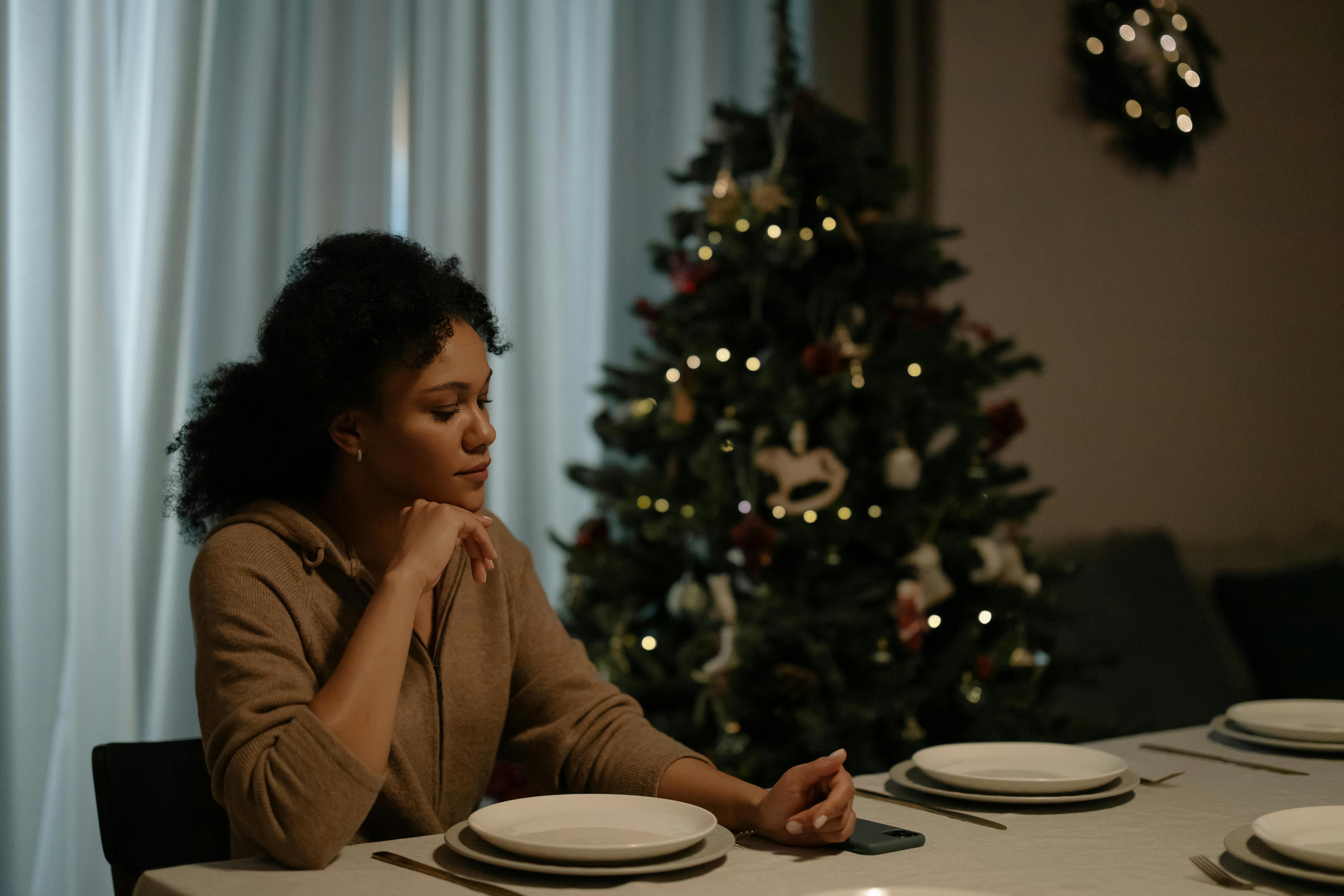
Family & Co-Parenting · Christmas Loneliness
Not the empty-house kind. The kind that lives quietly underneath a full, "fine" holiday — and the ache that people who haven't lived it can't quite reach.
Those numbers describe a feeling a lot of divorced women recognize instantly, even if they've never seen it measured before: a loneliness that doesn't look like loneliness from the outside. Not the empty-house, nobody-called kind. The kind that sits quietly underneath a full calendar, a warm dinner, a group text buzzing with holiday plans — the kind that's still there after you've hung up the phone with your sister, hugged your parents goodbye, and said "I'm doing great, this year's been good" for the fifth time that week.
This is that kind. The one nobody quite warns you about, because from the outside, your holidays look fine.
If you asked most of the people in your life whether you seemed lonely this Christmas, they'd probably say no — and they wouldn't be lying. You showed up. You laughed at the right moments. You brought a good dish to the gathering and complimented someone's tree. From the outside, a woman managing a full holiday schedule doesn't read as isolated.
But the isolation this survey data is picking up on isn't about your schedule. It's about the specific, ongoing loneliness of carrying a private grief through a public season — one where nearly everyone around you is celebrating something intact, and you're quietly holding something that isn't, without it being visible to anyone watching from a normal distance.
Here's the part that stings the most, and it's worth saying plainly: the people who love you and haven't been through a divorce genuinely cannot fully access this particular ache, no matter how much they want to. It isn't a failure of love or effort on their part. Grief that comes from an intact life falling apart has a specific shape that's very hard to understand from the outside, the same way someone who hasn't experienced infertility, or a miscarriage, or job loss at a certain scale often can't quite meet you where you are, even with the best intentions.
And there's an added layer most people don't talk about: even if you could explain it fully, a lot of divorced women don't want to. Not because the people around them wouldn't try to understand, but because there's a real difference between being understood and being pitied — and it's exhausting to risk the second one just to reach for the first. So the explaining stops, the "I'm fine" answer becomes the easier one, and the loneliness stays private by choice as much as by circumstance.
You don't owe anyone the full story just to be believed. It's completely reasonable to keep this specific ache close, share it only with the people who've actually lived something like it, and let "I'm doing okay" be a true enough answer for everyone else.
— JenniferOne of the most common places this loneliness shows up isn't during the big family gathering — it's right after. The last call of the day ends, the last "Merry Christmas, love you" gets said, and the house goes quiet in a way that has nothing to do with how the day actually went. That specific stretch — after the obligatory calls wrap up and before you're ready to sleep — is when a lot of women describe feeling the loneliness most sharply, precisely because there's nothing left scheduled to distract from it.
Naming that pattern in advance makes it less disorienting when it shows up. It's not a sign the day went badly. It's a predictable, common part of how this specific kind of loneliness tends to move through an otherwise full holiday.
Since you can't manufacture full understanding from people who haven't lived this, the more useful move is usually finding even a small number of people who genuinely have — a divorced friend, an online community built for exactly this, a therapist who specializes in this kind of transition. One or two people who truly get it tend to do more for this particular loneliness than a much larger circle of people who love you but can't fully meet you there.
It also helps to lower the bar for what "helping" needs to look like from everyone else. Your sister doesn't need to fully understand your grief to be a genuinely good, comforting presence on Christmas Day. Those two things — full understanding, and real comfort — don't have to travel together, and expecting them to often leads to disappointment that isn't actually about the people around you.
Worth remembering: Not being fully understood by everyone around you doesn't mean you're actually alone. It means this particular ache needs a smaller, more specific circle — and finding that circle, even if it's just one person, changes the whole shape of the season.
It's one of the most common things people say to someone they know is struggling, and it usually comes from a genuine place. But it also puts the entire burden of naming a need back on the person who's already carrying the most — and most divorced women, in the moment, don't have a specific ask ready to hand back. So the offer sits there, kindly meant and mostly unused, and the loneliness continues quietly underneath it.
If you're on the receiving end of that offer this season, it's worth giving yourself permission to actually take someone up on it with something concrete — "call me at 8 tonight" or "come sit with me while I wrap gifts" — rather than defaulting to "I'm okay, thank you though." Specific asks tend to get met. Vague ones, even well-intentioned, usually don't.
The data on holiday loneliness after divorce doesn't cancel out the good parts of your Christmas, and your good parts don't cancel out the loneliness either. Both are simply true at once, and most divorced women navigating this season honestly are holding both, all day, without it being a contradiction.
You can be genuinely grateful for the family who showed up, the kids who were happy, the dinner that came together — and still privately carry a loneliness that none of that quite touches. That's not ingratitude. It's just an accurate description of a complicated day, and it deserves to be named as clearly as the gratitude is.
You're Not as Alone in This as It Feels
Jennifer Johnson's coaching and courses connect women with real community and practical tools for rebuilding after divorce — especially through the seasons that feel loneliest.
Explore Life Refined™ Signature Reset → Or explore As She Rebuilds™ courses →
Jennifer built As She Rebuilds™ from lived experience navigating divorce — financially, emotionally, and personally. She helps women move from survival mode into stability, clarity, and renewed purpose. Learn more →