Family & Co-Parenting · Thanksgiving After Divorce
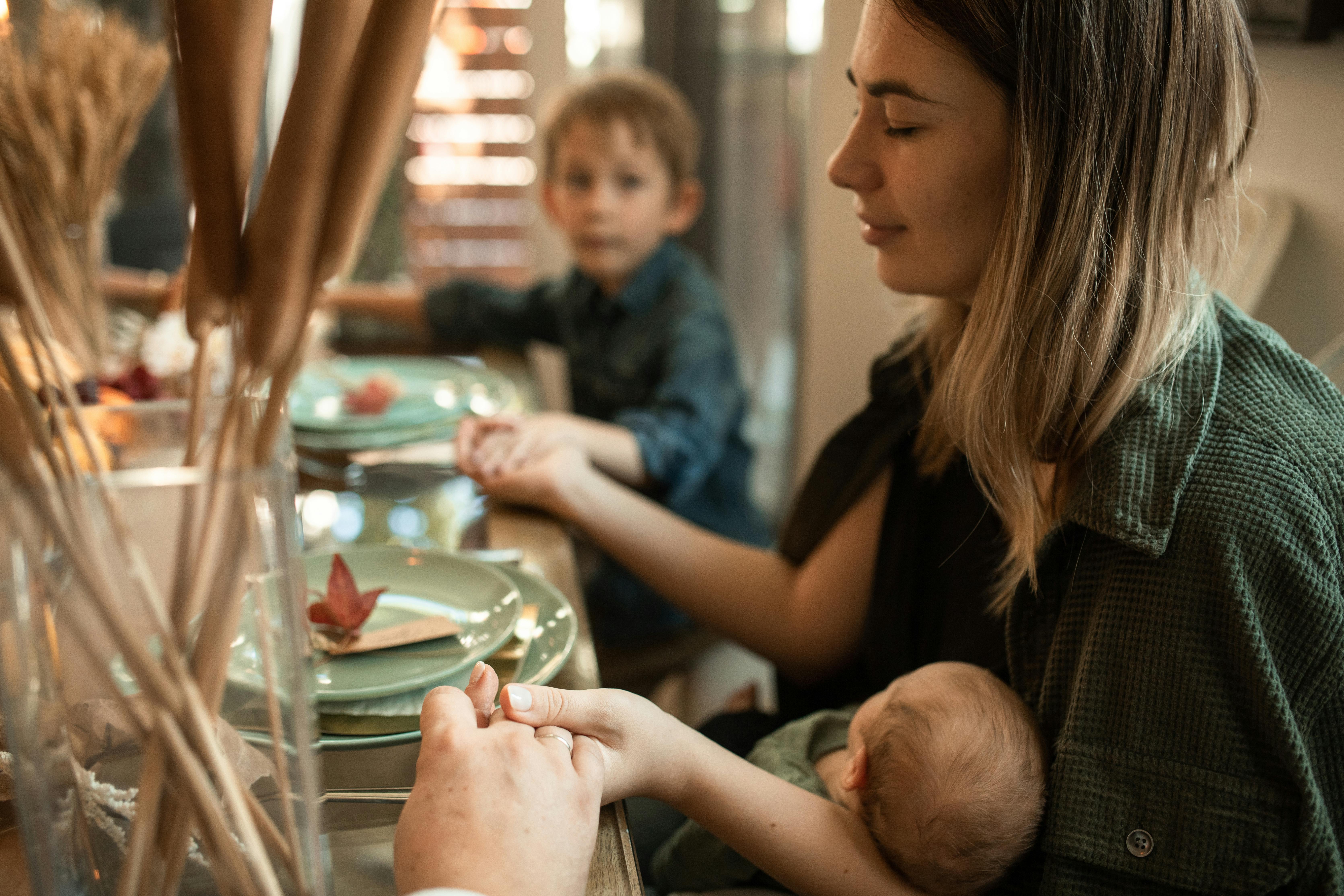
Fewer chairs doesn't mean less love. Here's how to build a smaller, warmer Thanksgiving your kids will actually remember.
According to the CDC's National Center for Health Statistics, the U.S. divorce rate stood at 2.4 per 1,000 people in the most recent reporting year. That number sounds clinical until you translate it into what it actually means this November: at tables all over the country, someone is setting out fewer plates than they used to, quietly bracing for the moment someone asks who's coming this year.
If that's you, take a breath. A smaller Thanksgiving table is not a smaller Thanksgiving. It's just a different shape — and different doesn't mean broken.
There's a particular kind of grief that shows up around a Thanksgiving table with empty chairs at it — chairs where an ex-spouse used to sit, where an in-law used to hold court, where the whole extended crowd used to squeeze in elbow to elbow. It's easy to measure the holiday by what's missing rather than by what's actually there.
But if you ask most adults what they remember about Thanksgivings from their childhood, the answers are rarely a headcount. They remember the smell of a specific pie. They remember a game that got too competitive. They remember someone's terrible jokes, or the year the gravy boat tipped over, or being allowed to stay up later than usual. The number of place settings almost never makes the list.
This matters because it means the thing you're worried about losing — the feeling of a "real" Thanksgiving — was never actually built on quantity. It was built on specific, repeatable moments of warmth. And you can absolutely build those with three people at the table just as well as with thirteen.
Reframe worth trying: Instead of asking "how do I make up for what's missing," try asking "what do I want this specific, smaller table to feel like?" It's a completely different — and much more answerable — question.
There's an unspoken rule in a lot of families that Thanksgiving has to be big to count — big table, big crowd, big production. If your first post-divorce Thanksgiving is smaller, quieter, or just you and your kids, it can feel like you're doing the holiday "wrong," even when nobody has actually said that out loud.
Here's the case for the small Thanksgiving nobody tells you: it's often calmer, more affordable, and far more within your control than the big productions of years past. There's no managing extended-family dynamics, no tiptoeing around who's not speaking to whom this year, and no exhausting performance of togetherness for an audience. A smaller table means you get to actually be present with the people who are there, instead of running a hosting operation for twenty.
Some of the women in coaching programs describe their first small, quiet Thanksgiving as the one where they finally exhaled — no drama to manage, no politics to navigate, just a meal they actually wanted to eat, at a pace they actually wanted to eat it. It's not the Thanksgiving they expected to have. Several say it's the one they'd choose again.
If you have kids, they are almost certainly taking their emotional cues about this holiday from you. Kids are remarkably good at sensing dread, even when adults think they're hiding it well. If you're approaching the day like something to survive, they'll likely absorb that same bracing energy — even if nobody says a word about the divorce out loud.
The flip side is just as true, and much more useful: if you approach the day with genuine, specific excitement about something — even something small — kids pick up on that too. "This year we're doing a pie-making contest, just us" lands completely differently than "this year is going to be different, but we'll get through it."
Give them one or two concrete things to anticipate. A new game. A movie after dinner that's just for your household. Full permission to eat dessert first, just this once, because the rules are yours to write now. Specificity beats vague reassurance every time with kids — "it'll be different but good" is abstract; "we're having a hot chocolate bar after dinner" is a plan they can actually look forward to.
A surprising amount of what makes a holiday feel warm has nothing to do with who's in the room and everything to do with deliberate sensory choices — the ones hosts make (often unconsciously) every year. Warm lighting instead of overhead fluorescents. A specific smell in the house, whether that's a roasting turkey, cinnamon, or a candle you only light this time of year. Music playing quietly in the background instead of silence or a blaring TV.
None of this requires a big budget or a big kitchen production. It requires intention. Dim the lights, put on a playlist, light something that smells like the season, and set the table with actual care even if it's only three plates. Small sensory rituals signal to everyone's nervous system — yours included — that this is a special day, regardless of guest count.
If cooking a full traditional spread feels like more than you have capacity for this year, it's worth remembering that "traditional" is a choice, not a requirement. Order the parts that stress you out most, simplify the menu drastically, or build an entirely new spread around foods your household actually loves. Nobody is grading your stuffing.
Grief counselors often describe grief in holidays as arriving in waves rather than as one continuous state — intense for a short window, then receding, then possibly returning later in the day. If you feel a sudden lump in your throat while setting the table, or find yourself unexpectedly tearing up over something as small as a song on the radio, that's not a sign you're doing this wrong. That's just a wave.
Waves are almost always brief — often just a few minutes — if you let them move through you instead of fighting them or trying to perform composure for your kids' sake. A useful, low-drama plan: if a wave hits, step into another room for two minutes, breathe, and rejoin when it passes. Kids don't need to see zero emotion from you; they need to see that emotion is survivable and doesn't derail the day. A parent who has one honest, brief moment and then rejoins the table models something far healthier than a parent performing constant, brittle cheerfulness.
It can also help to name the possibility out loud to yourself ahead of time: "I might have a hard moment today, and that's okay, and it will pass." Expecting the wave takes some of its power away.
New traditions don't erase the old ones — they just give this new chapter of your family something to hold onto that isn't tangled up in memories of what used to be. A few that women in similar seasons have found genuinely stick:
Pick one, not all five. New traditions work best when they're specific and repeated, not when the whole day gets reinvented at once.
There can be a quiet, unspoken guilt in actually enjoying a holiday after divorce — as if genuine happiness at a smaller table somehow betrays what used to be, or means the divorce "wasn't that bad" after all. It's worth naming that thought directly if it shows up, because it's not true and it doesn't deserve the space it takes up in your head.
Enjoying this Thanksgiving doesn't erase or minimize anything difficult about the year you've had. It simply means you're allowed to build something good in the present, on its own terms, without it having to relate back to what came before. Your kids don't need you to grieve the old table in order to validate that it mattered. They need you to build a genuinely good new one.
This year's table might be smaller. It might be quieter. It might look nothing like the Thanksgivings of years past. That doesn't make it less real, less worthy, or less full of the specific, sensory, repeatable warmth that actually makes a holiday memorable. Set the table with intention, give your kids something specific to look forward to, let the waves pass through when they come, and let yourself actually enjoy the day you've built.
Build a Season You're Proud Of
Jennifer Johnson's coaching and courses help women build steady, intentional lives after divorce — including holidays that actually feel good, not just survivable.
Explore Life Refined™ Signature Reset → Or explore As She Rebuilds™ courses →
Jennifer built As She Rebuilds™ from lived experience navigating divorce — financially, emotionally, and personally. She helps women move from survival mode into stability, clarity, and renewed purpose. Learn more →